Decoding Low Barrel Entry Proof: Buffalo Trace Experimental Collection
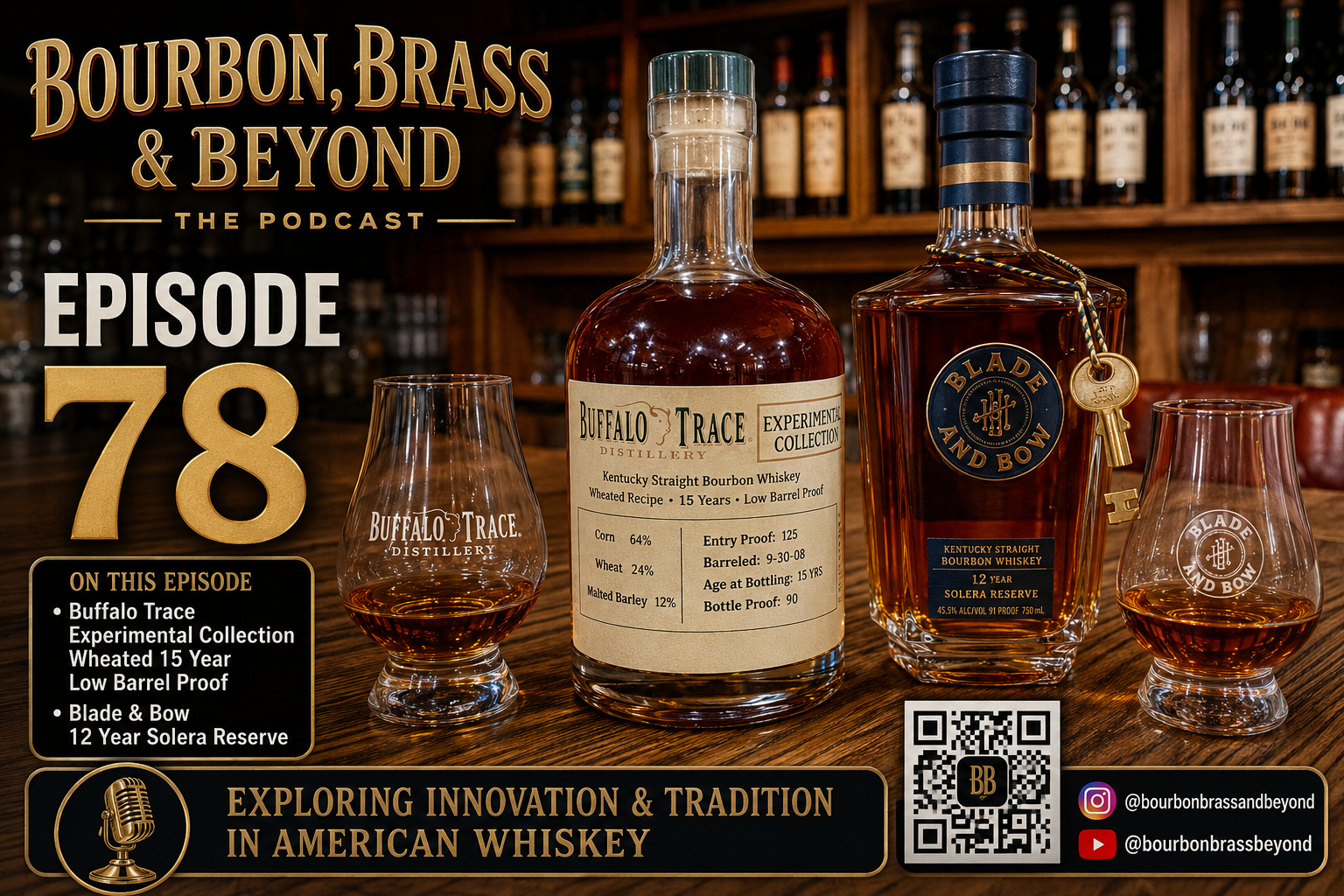
Welcome back to the Bourbon, Brass & Beyond blog! Today, we are diving deep into one of the most fascinating scientific and sensory rabbit holes in the entire whiskey industry: barrel entry proof. If you are a bourbon aficionado, you likely know that the proof at which a distillate goes into the barrel can dramatically shape its destiny. But what happens when distillers decide to break convention, lower that entry proof significantly, and let a wheated mashbill sleep for a decade and a half? To find out, we recently explored a truly remarkable bottle on the podcast: a 15-year wheated release from the Buffalo Trace Experimental Collection. In this post, we are going to expand on those tasting notes, unpack the science of low barrel entry proof, and examine why this technique yields such incredible brown butter and sweet dessert profiles. If you enjoy this deep dive, you will definitely want to listen to our full discussion in 15 Year Wheated Buffalo Trace Experimental and Blade & Blow 12 Year; Ep. 78.
Introduction to the Buffalo Trace Experimental Collection
The Buffalo Trace Experimental Collection is essentially a playground for the senses, albeit a heavily scientific and meticulously planned one. For years, the master distillers and warehouse managers at Buffalo Trace have been asking "what if?" questions. What if we use a different grain? What if we warehouse the barrels on a specific floor? What if we alter the entry proof? By releasing these small-batch experiments, Buffalo Trace allows consumers and whiskey nerds to taste the individual variables that go into making iconic bourbons.
Most commercial bourbons today are entered into the barrel at relatively high proofs—often around 125 proof. This practice became standard across the industry largely for economic and volumetric efficiency during the mid-to-late 20th century. However, historical distilling practices frequently utilized much lower entry proofs. When Buffalo Trace rolls out an experimental bottle featuring a non-traditional specification, it provides a rare window into distilling history and wood chemistry. Our recent podcast episode focused heavily on one such unicorn: a 15-year-old wheated bourbon entered into the barrel at a remarkably low proof. Let us explore why that single variable changes everything.
Understanding Barrel Entry Proof and Its Role in Bourbon Aging
To truly appreciate a low barrel entry proof bourbon, we need to geek out for a moment on the science of maturation. When a distillate is filled into a charred oak barrel, it is not just sitting there quietly; it is engaged in a complex chemical dialogue with the wood. Water and ethanol act as solvents, extracting various compounds from the oak—such as sugars, tannins, lactones, and lignin breakdown products like vanillin.
Here is where the entry proof comes into play. Ethanol and water extract different compounds at different rates. Water is a better solvent for polar compounds (like wood sugars and certain tannins), while high-concentration ethanol is better for non-polar compounds (like oak lactones and specific aromatic oils). When a barrel is filled at a high proof, say 125 proof, the liquid is roughly 62.5% alcohol by volume. As the bourbon ages, water and alcohol interact with the wood differently, and evaporation (the angel's share) changes the proof over time.
Historically, many legendary bourbons were entered into barrels at much lower proofs, often around 100 to 110 proof, or even lower. Lower entry proofs mean more water is present in the barrel from day one. Water penetrates deeper into the wood staves, unlocking water-soluble sugars and caramel compounds much earlier and more thoroughly in the aging process. Furthermore, lower entry proof bourbons tend to pick up less harsh, drying wood tannins over long periods of extended aging compared to their high-proof-entry counterparts. This creates a smoother, sweeter, and more integrated spirit by the time it reaches maturity.
Unpacking the 15-Year Wheated Experimental Release
Now, let us turn our attention to the star of the show: the 15-Year Wheated Buffalo Trace Experimental Collection release. Distilled back in 2010, this liquid spent a staggering fifteen years interacting with oak. Fifteen years is a long time in the rickhouses of Kentucky. For many high-entry-proof bourbons, fifteen years in wood can result in an over-oaked, dry, intensely tannic profile that tastes like chewing on a piece of lumber. But because this experimental batch utilized a low barrel entry proof combined with a soft wheated mashbill, the wood influence remained remarkably balanced.
Wheated bourbons—which substitute rye with wheat as the secondary grain—are already known for being softer, smoother, and sweeter on the palate than their high-rye cousins. Think of legendary wheated profiles like Weller or Old Fitzgerald. When you take that inherently gentle, sweet wheated mashbill, age it for fifteen years, and pair it with a low barrel entry proof, you create a completely unique chemical environment. The barrel has time to impart deep, complex secondary and tertiary flavors without overwhelming the delicate grain characteristics.
When we poured this expression on the podcast, the anticipation in the room was palpable. Rare experimental releases carry a certain mystique, but when you nose a glass that has been aged for a decade and a half under non-standard conditions, you realize you are tasting liquid history. The interaction between the low proof spirit and the char of the barrel had worked absolute magic over those fifteen years.
Tasting Notes: Exploring Brown Butter and Sweet Dessert Profiles
Let us get into the most exciting part of any bourbon journey: the sensory experience. How does a 15-year low-entry-proof wheated bourbon actually taste in the glass? To put it simply, it is an absolute dessert bomb, but with a level of elegance and sophistication that prevents it from ever feeling cloying.
On the nose, the moment you bring the glass up, the immediate reaction is one of disbelief. As we noted on the show, it instantly evokes comparisons to some of the most sought-after ultra-aged whiskeys on the planet. Someone in the room remarked, "That's like a Pappy nose. That's so sweet." There is an undeniable rush of confectionary sugar, rich vanilla bean, and old, polished oak that lacks any sort of aggressive ethanol prickle.
Moving to the palate, the low entry proof truly shines. Instead of a spicy, high-proof kick, the mouthfeel is luxurious, coating, and velvety. Flavor notes unfold in waves, starting with a decadent richness that led us straight to a specific culinary description: "I got like a brown butter bourbon flavor." Alongside that toasted, nutty, caramelized brown butter note, you find layers of baked peach, cinnamon-sugar pastry crust, maple syrup, and a hint of dark chocolate.
The finish is long, warm, and comforting. It doesn't dry out your mouth the way an over-extracted 15-year-old high-entry-proof whiskey might. Instead, it lingers with sweet baking spices and a residual creaminess that makes you want to immediately take another sip. As we discussed on the air, "This is the kind of bourbon you have at the end of the day," a meditative pour meant for quiet reflection and true appreciation.
Comparing Low Entry Proof Bourbons to Traditional Releases
To truly understand why this Buffalo Trace experimental bottle is so special, it helps to compare it side-by-side with mainstream, traditional releases. Most modern commercial bourbon is barreled at high proofs primarily for economic efficiency. Distillers can fit more gallons of whiskey into a warehouse if the liquid going into the barrels is high proof. However, many whiskey historians and purists argue that modern high-entry-proof bourbons require more dilution with water before bottling to reach the standard 80 to 100 proof, and that water addition can sometimes flatten the flavor profile.
When a bourbon is entered into the barrel at a lower proof, it naturally ages closer to its bottling strength. Because the barrel liquid is already lower in alcohol, the wood extracts sweeter, more harmonious flavors over time rather than aggressive tannins. If you compare a traditional 125-proof-entry bourbon aged for 12 to 15 years against a low-entry-proof counterpart, the structural differences are stark. The traditional release might lean heavily into leather, tobacco, heavy oak, and dry spice, whereas the low-entry version leans into honey, butterscotch, pastry notes, and velvety smoothness.
While both styles have their rightful place in a well-rounded whiskey cabinet, the low-entry-proof style offers a glimpse into how bourbon used to taste decades ago. It reminds us that patience, chemistry, and intentional adjustments to the foundational variables of whiskey-making can yield entirely new dimensions of flavor.
Final Thoughts on Innovation and the Future of Bourbon Crafting
The Buffalo Trace Experimental Collection reminds us why the modern bourbon renaissance is so thrilling. Distilleries do not have to rest on their laurels; they can experiment, test hypotheses, and challenge industry norms to see what happens. Lowering the barrel entry proof is a labor-intensive, less economically efficient choice, but as this 15-year wheated release proves, the payoff in the glass can be nothing short of extraordinary.
Whether you are hunting for rare allocated bottles, planning a pilgrimage to Kentucky distilleries, or simply sitting on your back porch exploring a new pour with friends, understanding the nuances of how your whiskey is made adds an incredible layer of enjoyment to the hobby. The science of barrel aging is vast, and every bottle tells a story of wood, time, and human craftsmanship.
If you want to hear more about our tasting notes, our thoughts on the Blade and Bow 12 Year Solera Reserve, and our excitement for our upcoming interviews and tastings with the Van Winkle family, you need to check out the complete episode. Grab your favorite glass, sit back, and listen to 15 Year Wheated Buffalo Trace Experimental and Blade & Blow 12 Year; Ep. 78. Cheers, and until next time!

Pilot / Dad / Trumpeter / Contract Negotiator / Martial Artist
In his 26th year as an airline pilot, Dan resides in Youngstown, Ohio with his high school sweetheart Stephanie. Combined they have 5 kids (teenagers...). They enjoy travel as a family, and as a couple. Dan has had a bourbon affinity since smelling his Grandfather's JW Dant and Grapefruit soda as a kid. Dan started collecting bourbon in 2015. He has been actively involved in Martial Arts since he was a kid and has Black Belts in two different styles. Dan still plays trumpet. Originally he went to college for music at Ohio University, but after his sophomore year decided he would much rather spend 3 hours in an airplane instead of a practice room. He still helps teach high school band camps, and has assisted with 5th and 6th grade Trumpet, Low Brass, and Percussion. Dan has been a Pilot Union Representative, Contract Negotiator, Merger Specialist, and Contract Compliance Administrator for over 20 years. Dan received the President's Lifetime Achievement Volunteer Service Award in 2024.
Penelope Omega 11 Year vs. Maker's Mark 46 Cask Strength: The Ultimate Breakdown