A Decade of Tennessee Whiskey: Comparing Jack Daniel's 10, 12, and 14 Year Releases
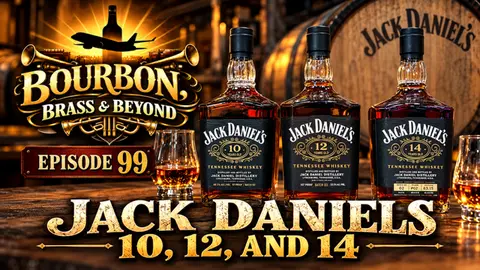
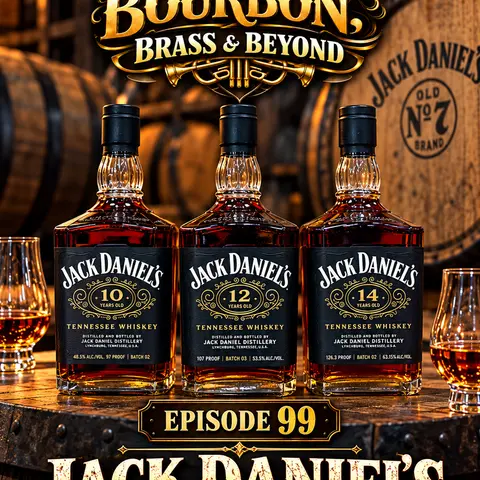
Welcome back to the Bourbon, Brass & Beyond blog! If you are a regular listener of our podcast, you know we live for deep dives into the most sought-after bottles in the whiskey world. Recently, we recorded a major milestone episode—our ninety-ninth installment—where we looked back at how far our palates, our recording studio, and our community have come over the last year. To celebrate, we opened up one of the most exciting vertical tastings of the modern American whiskey landscape: the complete age-stated Jack Daniel's series featuring the 10, 12, and 14-year releases. If you want to listen to us debate proof, heat, and value in real-time, be sure to check out Ep. 99 — 99 Problems, The Bourbon Ain't One. For those who prefer to read the tasting notes, let us break down how a century of distilling tradition translates into these dark, oak-heavy Tennessee whiskeys.
The Evolution of Jack Daniel's: An Overview of the Age-Stated Series
For decades, the standard Old No. 7 and the ever-popular Jack Daniel's Single Barrel barrel proof offerings defined the brand for the general public. While those bottles have legions of devoted fans, whiskey enthusiasts often craved something older, something deeply influenced by extended barrel maturation in the specific rickhouses of Lynchburg, Tennessee. That all changed when Jack Daniel's introduced their age-stated series, pushing the envelope with 10-year, 12-year, and now 14-year age statements.
These releases have captured the imagination of collectors and casual sippers alike, largely due to the unique maturation conditions found at Jack Daniel's. Sitting comfortably in top-floor aging locations or deep within the sprawling barrel houses, this liquid interacts aggressively with the oak over a longer period. The resulting whiskey is dark, rich, and dramatically different from standard-issue Tennessee whiskey. But as the age goes up, so does the price tag, the secondary market hype, and the debate over diminishing returns. Let us walk through the lineup bottle by bottle to see how they truly compare.
Jack Daniel's 10 Year: Easy-Drinking, But Does It Lack Complexity?
We kicked off our vertical tasting with the Jack Daniel's 10 Year old. This is the bottle that started the age-stated craze, generating immense buzz upon its initial batches. Pouring a glass, you immediately notice a rich, dark amber color that hints at significant wood interaction right out of the gate.
On the nose, the 10-year delivers classic Tennessee whiskey characteristics: sweet vanilla, toasted oak, and a background note of baking spices. Taking your first sip, the mouthfeel is surprisingly approachable and smooth. It is an exceptionally easy-drinking whiskey, lacking any harsh or abrasive ethanol burn that you might expect from a higher-proof limited release. It glides across the palate with pleasant notes of brown sugar, caramel, and a touch of traditional charcoal-mellowed sweetness.
However, as we sat with the pour and discussed it on the air, a common critique emerged. While the 10 Year is undeniably delicious and dangerously drinkable, it tends to plateau. It lacks the deep, evolving layers of complexity that whiskey nerds look for in older, allocated bottles. It gives you a great initial wave of flavor, but the finish drops off relatively quickly without introducing secondary or tertiary notes. For those looking for an introductory pour into aged Tennessee whiskey, it is a massive win. For seasoned collectors chasing a mind-blowing flavor journey, it leaves you wondering what the older siblings in the lineup can do.
Jack Daniel's 12 Year: Sweetness, Layers, and the Sweet Spot
Stepping up to the Jack Daniel's 12 Year old feels like moving into an entirely different tax bracket of flavor. If the 10 Year is an easy-drinking crowd-pleaser, the 12 Year is where the master distillers truly begin to showcase what extended aging can achieve in these barrels.
The color deepens further, bordering on a rich mahogany. When you swirl it in the glass, the legs are slower and heavier. On the nose, the oak influence steps forward, bringing along waves of dark chocolate, rich caramel, and a distinct, delightful note of toasted marshmallow. There is an added richness here that immediately signals a more mature spirit.
On the palate, the 12 Year hits that elusive sweet spot. It delivers an explosion of spice, sweet brown sugars, and layered dessert notes that evolve as the whiskey sits on your tongue. The mid-palate introduces hints of roasted nuts and pipe tobacco, rounding out the sweetness with a pleasant, dry oak structure. The finish is longer, warmer, and far more complex than its 10-year predecessor. During our recording, both of us kept coming back to the 12 Year as the harmonious balance of age, drinkability, and deep flavor profile. It is the bottle from this series that genuinely turns skeptics into believers.
Jack Daniel's 14 Year: Heat, Molasses, and Ultimate Complexity
Finally, we arrived at the crown jewel of the current lineup: the Jack Daniel's 14 Year old. With age comes wisdom, but in the world of high-proof whiskey, age also brings serious barrel influence and plenty of heat.
Pouring the 14 Year, you are greeted with a remarkably dark, almost opaque liquid that looks more like aged rum or heavy maple syrup than standard whiskey. The extra years spent in the barrel allow the wood to impart a massive structural backbone to the spirit. On the nose, you get heavy charred oak, leather, dark fruit, and a deep, earthy molasses note that commands your attention.
When you take your first sip, you immediately notice the step up in intensity. The heat is significantly more prominent here, warming the chest and demanding a slower, more deliberate sipping experience. But that heat is backed by an incredible wealth of flavor. Notes of thick molasses, burnt sugar, espresso bean, and complex leather dominate the palate. It is the most challenging pour of the three, but it is also easily the most complex. It is a whiskey that rewards patience, opening up wonderfully with a few drops of water or a few minutes of rest in the glass.
Value, Availability, and Navigating Secondary Market Hype
Of course, discussing incredible whiskey is only half the battle. In today's bourbon and American whiskey market, you also have to address the elephant in the room: availability and price.
Retail pricing for these bottles is generally reasonable given their age statements and limited production numbers, but finding them on a shelf at suggested retail price (MSRP) is a rare sport. As you move from the 10 Year up to the 14 Year, the secondary market hype multiplies exponentially. The 10 Year commands a notable markup, the 12 Year commands a heavy premium, and the 14 Year is firmly in "unicorn" territory for many casual collectors.
This brings up the classic tater culture debate that we frequently tackle on the podcast. Is the 14 Year worth paying triple or quadruple its retail value on the secondary market? That depends entirely on your budget and how much you value extreme oak depth over overall balance. While the 14 Year is a phenomenal, highly complex pour, the 12 Year often represents the smarter buy for actual consumption. It delivers 90 percent of the complexity at a fraction of the secondary headache.
Final Verdict: Which Jack Daniel's Age-Stated Bottle Is Worth the Hunt?
Reflecting on our journey through the Jack Daniel's 10, 12, and 14 Year expressions—while simultaneously celebrating our 99th podcast episode—reminds us why we fell in love with this hobby in the first place. The evolution of these liquids mirrors our own evolution as podcasters and whiskey enthusiasts: constantly learning, refining our palates, and appreciating the nuances that time and craftsmanship bring to a glass.
So, which bottle is worth the hunt? If you stumble across the 10 Year at a fair price, snap it up for an ultra-smooth, crowd-pleasing pour that anyone can enjoy. If you want the ultimate sweet spot of rich marshmallow, baking spices, and layered complexity, make the 12 Year your primary target. And if you are a hardcore oak fiend who loves bold heat, rich molasses, and maximum depth of flavor, the 14 Year is the holy grail you need to track down.
To hear all of our live reactions, funny tangents, and complete reflections on our first 99 episodes, head over and listen to Ep. 99 — 99 Problems, The Bourbon Ain't One. Thank you for reading, thank you for listening, and we will see you for our massive episode 100 celebration!

Pilot / Dad / Trumpeter / Contract Negotiator / Martial Artist
In his 26th year as an airline pilot, Dan resides in Youngstown, Ohio with his high school sweetheart Stephanie. Combined they have 5 kids (teenagers...). They enjoy travel as a family, and as a couple. Dan has had a bourbon affinity since smelling his Grandfather's JW Dant and Grapefruit soda as a kid. Dan started collecting bourbon in 2015. He has been actively involved in Martial Arts since he was a kid and has Black Belts in two different styles. Dan still plays trumpet. Originally he went to college for music at Ohio University, but after his sophomore year decided he would much rather spend 3 hours in an airplane instead of a practice room. He still helps teach high school band camps, and has assisted with 5th and 6th grade Trumpet, Low Brass, and Percussion. Dan has been a Pilot Union Representative, Contract Negotiator, Merger Specialist, and Contract Compliance Administrator for over 20 years. Dan received the President's Lifetime Achievement Volunteer Service Award in 2024.

Before You Toss It: Why You Need an Estate Sale Assessment