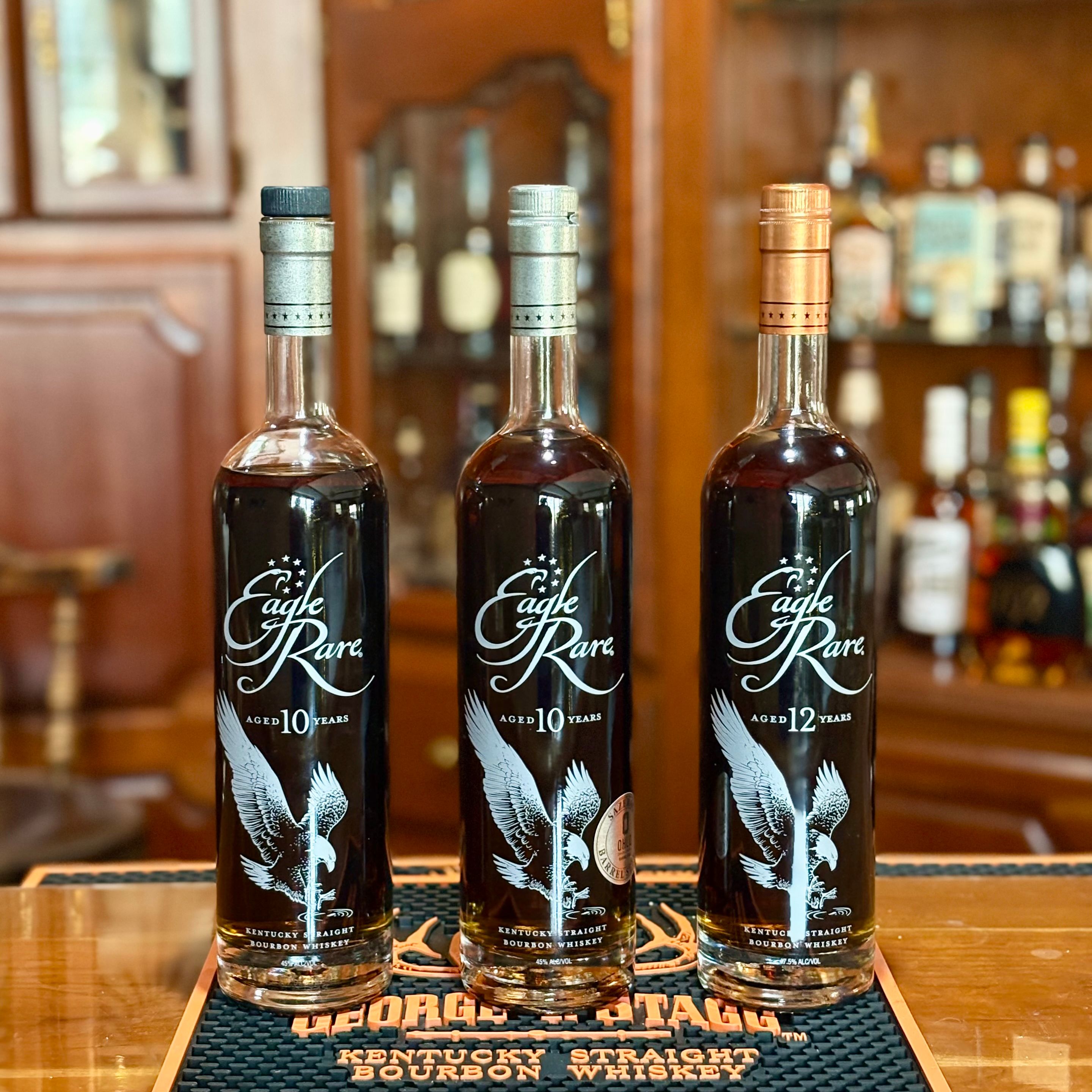
We taste Buffalo Trace Mashbill #1 and Eagle Rare 10 year/12 year, and 10 year Barrel Select

Buffalo Trace Distillery has over 20 Brands of Bourbon/Whiskey. All of these brands come from four distinct mash bills. The recipes for these mash bills are not published, but there is a lot of information surfing the web. We know Mash bill #1 is the low Rye Recipe. Mash bill #2 is the high Rye Recipe, Mash bill #3 is the Wheated Mash bill Recipe, and Mash bill #4 is the Rye Whiskey Recipe.
Depending on the source used from the web, Mash bill #1 is approximately 7% Rye, 89.5% Corn, and 3.5% Malted Barley. Mash bill #2 is approximately 9-12% Rye, 84.5-87.5% Corn, and 3.5% Malted Barley. Mash bill #3 is 76.5% Corn, 20% Wheat, and 3.5% Malted Barley. Mash bill #4 is 55% Rye, 41.5% Corn, and 3.5% Malted Barley.
In this blog, we will discuss Mash bill #1. The low Rye Mash bill. This mash bill was not in use until it was introduced in 1992. Before that time, Mash bill #2 was the primary mash bill for Buffalo Trace products.
The following Buffalo Trace Products come from Mash Bill #1:
- Buffalo Trace Bourbon
- Col. E.H. Taylor Bourbons
- Eagle Rare Bourbons
- Stagg/George T. Stagg Bourbons
- Bowman Bros. Bourbons
- Benchmark Bourbons
- Old Charter Bourbons
Why the different brands and tasting profiles?
Although these bourbons are all derived from the same yeast, fermentation process, mash bill, and new oak barrels, that is where the similarities end. Different char levels of the barrels, aging, rickhouse placement, and floor location of the barrels all make significant differences in the taste. Barrels aged on high floors tend to be sweeter, spicier and richer due to higher heat in the summer and colder winters with better airflow. This causes contraction out of the barrel wood in colder temps and expansion of the liquid into the wood in higher temps. This draws the sweetness and spice from the wood into the whiskey. Rickhouses with higher airflow or heat will create a different taste profile compared to cooler or more damp rickhouses. Hardin's Creek Bourbon line is a prime example of using different environments to showcase different tastes of the same barreled juice aged in different locations. Dramatically different tastes from bourbons which were the exact same liquid, same age, and same barrels- just aged in different locations/rickhouses and on lower or higher floors.
For example, Buffalo Trace Bourbon is a batching or mixture of all the different barrel locations. That is to create the most uniform and even taste profile. The barrels are all aged between 7-9 years. Buffalo Trace Bourbon does not have an age statement, but BT says they are a minimum of 8 years old.
Eagle Rare Bourbons are all single barrel bourbons. Each bottle is from one barrel and is not mixed with juice from any other barrels. Since each barrel will have different taste from the one sitting right next to it, that means each bottle will be slightly to sometimes significantly different. The minimum age on Eagle Rare is 10 years, which is two more years of aging compared to Buffalo Trace Bourbon.
Another difference in the brands of this mash bill is the bottle proof. Barrel entry proof varies, but is generally between 105-125 proof when the white dog goes into the barrel. Exit proof may be in the similar range. Water is then added to bring the bourbon down to bottle proof. Eagle Rare 10 year is bottled at 90 Proof. Eagle Rare 12 year is bottled at 95 proof. Col Taylor's is normally bottled at 100 proof, and so on. When proofing down or adding water, it can open up different flavors in the bourbon, but also reduce viscosity and thin the bourbon creating a different texture.
Barrel Proofs/Cask Strength has become increasingly popular, not necessarily because of the high alcohol content, but because of the viscosity, texture, and finish bourbons provide from the barrel.
In the last 20 years, many of the volume distillers have increased or raised barrel entry proof. Instead of adding liquid to new barrels at 105 proof, they have begun adding it at 125 proof. That means after ageing, you add more water to the remaining volume to get the proof down- thus producing more bottles per barrel. and higher profits. "Old Dusties" or older bottlings of the same brand taste significantly different than todays bourbons. It is thicker, with a much richer finish. They also have a more buttery feel, as they were not chill filtered which takes out many of the natural fats.
On the podcast we have talked about and tried multiple old dusties. And quite frankly they are phenomenal and worth it. They keep increasing in price, because they cannot be recreated and they are only going down in availability. Even "shelfers" from the 1970's and 1980's are now in the thousands.
So, done rambling on. Please watch and listen to our Eagle Rare Podcast. Please like and give 5 stars.
Thanks for supporting Bourbon, Brass & Beyond,
Dan

Pilot / Dad / Trumpeter / Contract Negotiator / Martial Artist
In his 26th year as an airline pilot, Dan resides in Youngstown, Ohio with his high school sweetheart Stephanie. Combined they have 5 kids (teenagers...). They enjoy travel as a family, and as a couple. Dan has had a bourbon affinity since smelling his Grandfather's JW Dant and Grapefruit soda as a kid. Dan started collecting bourbon in 2015. He has been actively involved in Martial Arts since he was a kid and has Black Belts in two different styles. Dan still plays trumpet. Originally he went to college for music at Ohio University, but after his sophomore year decided he would much rather spend 3 hours in an airplane instead of a practice room. He still helps teach high school band camps, and has assisted with 5th and 6th grade Trumpet, Low Brass, and Percussion. Dan has been a Pilot Union Representative, Contract Negotiator, Merger Specialist, and Contract Compliance Administrator for over 20 years. Dan received the President's Lifetime Achievement Volunteer Service Award in 2024.

Family Legacies and Future Visions: The Story of Log Still Distillery